
USD/INR jumps to two-week high on Trump’s tariff threats, geopolitical risks
- The Indian Rupee declines against the US Dollar at the start of the week, with the USD/INR rising to near 90.50.
- US President Trump threatens to raise tariffs on imports from India.
- Market sentiment turns sour as the US strikes Venezuela.
The Indian Rupee (INR) slides to a fresh almost two-week low against the US Dollar (USD) at the open on Monday. The USD/INR pair jumps to near 90.50 as the Indian currency weakens, following threats from United States (US) President Donald Trump that he could further raise tariffs on imports from India for not supporting Washington in resolving the Russian oil issue.
“We could raise tariffs on India if they don't have help on Russian oil issue,” US President Trump said, Reuters reported. Trump added, “They wanted to make me happy, basically PM Modi's a very good man. He's a good guy. He knew I was not happy. It was important to make me happy. They do trade, and we can raise tariffs on them very quickly."
The tariff threat from US President Trump on India has renewed trade frictions between the two nations. In 2025, Trump raised import duties on India to 50%, which included punitive 25% tariffs for buying Oil from Russia.
Trade tensions between the US and India led to a significant increase in the demand for the US Dollar by Indian importers and an outflow of foreign funds from the Indian stock market. Strong demand for the US Dollar pushed the USD/INR pair to its lifetime high at 91.55 and forced the Reserve Bank of India (RBI) to intervene in spot and Non-Deliverable Forward (NDF) markets to support the Indian Rupee.
In 2025, Foreign Institutional Investors (FIIs) pared their stake worth Rs. 3,06,418.88 crore in the Indian equity market. FIIs have also turned out to be overall net sellers in the first two trading days of January 2026 and have offloaded their stake worth Rs. 2,978.80 crore.
Daily Digest Market Movers: US Dollar gains on geopolitical risks
- A positive weekly start by the USD/INR pair is also driven by strength in the US Dollar due to risk-off market sentiment. During the press time, the US Dollar Index (DXY), which tracks the Greenback’s value against six major currencies, trades 0.35% higher to near 98.80.
- Investors turn risk-averse following the US’ strike on Venezuela and the capture of President Nicolas Maduro against drug-trafficking charges in New York, and threats from US President Trump to take action on Colombia and Iran too.
- Escalating geopolitical risks have forced investors to shift to the safe-haven fleet, improving demand for bullion, base metals, and the US Dollar.
- US President Trump has also stated that Washington will take over and restructure Venezuela’s Oil industry, which accounts for 7% of global reserves or 303 billion barrels, according to the London-based Energy Institute.
- The impact of the US-led takeover of Venezuela’s Oil industry is expected to be significant for the Indian economy, assuming that the additional supply of Oil will lower energy prices. Given that India is one of the largest Oil-importing countries in the world and meets 85% of its energy needs from imported Oil, lower crude prices will be favorable for the Indian Rupee.
- Going forward, the US Dollar is expected to trade with volatility in a US data-packed week, starting from the ISM Manufacturing Purchasing Managers’ Index (PMI) data for December, which will be published at 15:00 GMT. The ISM Manufacturing PMI is expected to come in mildly higher at 48.3 from 48.2 in November, suggesting that activity has contracted again, but at a slightly moderate pace.
- This week, the notable release will be the Nonfarm Payrolls (NFP) data for December, which is scheduled to be released on Friday. The US NFP data will have a significant influence on market expectations for the Federal Reserve’s (Fed) monetary policy announcement later this month.
- According to the CME FedWatch tool, the Fed is expected to hold interest rates steady in the current range of 3.50%-3.75% in the policy announcement on January 28.
Technical Analysis: USD/INR rises to near 90.50
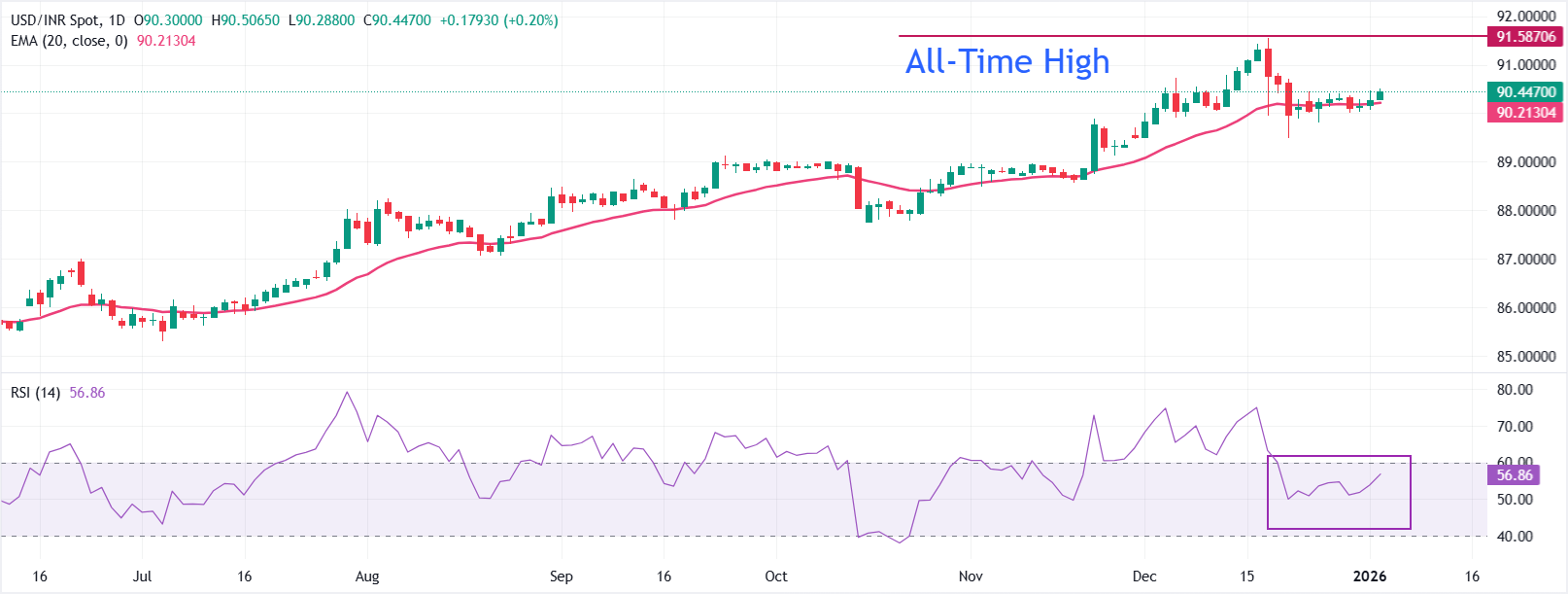
In the daily chart, USD/INR trades at 90.4470. The 20-day Exponential Moving Average (EMA) slopes higher at 90.2130, maintaining a modest bullish bias. Price holds above the gauge, indicating dip demand persists.
The 14-day Relative Strength Index (RSI) at 56.86 is rising, confirming firming momentum.
Initial support sits at the rising 20-EMA; a daily close beneath it would temper the upside and lead to a deeper retracement towards the December low of 89.50. While, the all-time high of 91.55 will remain a key barrier on the upside.
(The technical analysis of this story was written with the help of an AI tool.)