
US Dollar Index retreats from Iran war highs as safe-haven bid fades
- The US Dollar Index eased on Tuesday as markets find their risk bids.
- Market tensions remain half-cocked after US Energy Secretary Wright walked back a claim the US had escorted a ship through the Strait of Hormuz.
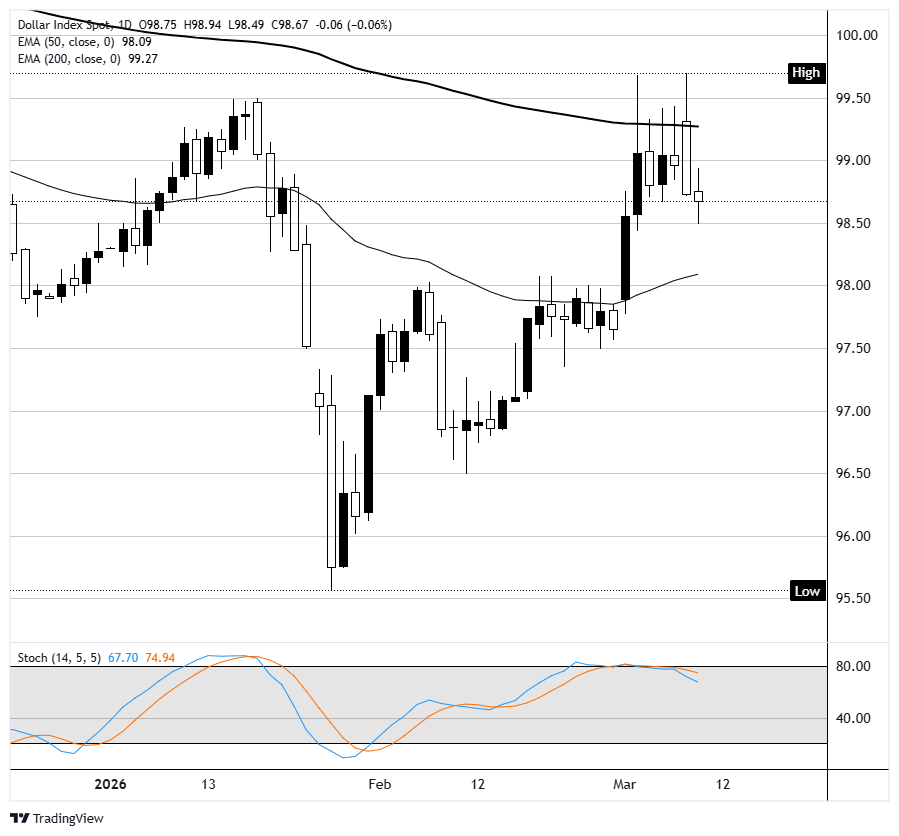
The US Dollar Index (DXY) fell into 98.50 on Tuesday, pulling back from last week's highs as safe-haven demand eased following President Trump's comments suggesting the Iran war is nearing its end.
The session told a story of conflicting narratives. On one hand, US President Donald Trump repeated that the war was "very complete, pretty much," and Oil prices plunged around 10% as the International Energy Agency (IEA) convened an emergency meeting on strategic crude reserve releases. On the other, Defense Secretary Pete Hegseth said Tuesday would be the US military's "most intense day of strikes" of the entire campaign, with reports of heavy bombardment targeting Kish Island off Iran's southern coast. Adding to the confusion, Energy Secretary Chris Wright posted on social media that the US Navy had successfully escorted an oil tanker through the Strait of Hormuz, then deleted the post. Reuters subsequently confirmed the withdrawal. The episode raised fresh questions about whether escort operations are actually underway and dented the credibility of the administration's assurances on restoring Crude Oil flows through the critical chokepoint.
Key US inflation data rounds the corner
The week ahead is loaded with high-impact US data that will shape the Dollar's next move. Wednesday's Consumer Price Index (CPI) report for February at 12:30 GMT is the main event, with headline CPI expected at 0.3% month-over-month and 2.4% year-over-year, and core CPI forecast at 0.2% month-over-month. The data was collected before the Iran war began, so it won't reflect the energy price shock — but any upside surprise would reinforce the Fed's hawkish hold. Thursday brings initial jobless claims (consensus 215K) and a speech from Fed Governor Bowman at 19:00 GMT. Friday is packed: preliminary Q4 Gross Domestic Product (GDP), January core Personal Consumption Expenditures (PCE) at 12:30 GMT, plus the University of Michigan (UoM) consumer sentiment index and Job Openings and Labor Turnover Survey (JOLTS) data later in the session.
The big picture
The big picture driver remains the Iran conflict. If geopolitical risks escalate again or Oil prices reverse higher, the Dollar's safe-haven bid could return quickly. But if the conflict winds down as Trump has suggested, DXY is vulnerable to further downside as the war premium unwinds and rate cut expectations recalibrate. Wednesday's CPI is the next catalyst.
DXY daily chart
US Dollar FAQs
The US Dollar (USD) is the official currency of the United States of America, and the ‘de facto’ currency of a significant number of other countries where it is found in circulation alongside local notes. It is the most heavily traded currency in the world, accounting for over 88% of all global foreign exchange turnover, or an average of $6.6 trillion in transactions per day, according to data from 2022. Following the second world war, the USD took over from the British Pound as the world’s reserve currency. For most of its history, the US Dollar was backed by Gold, until the Bretton Woods Agreement in 1971 when the Gold Standard went away.
The most important single factor impacting on the value of the US Dollar is monetary policy, which is shaped by the Federal Reserve (Fed). The Fed has two mandates: to achieve price stability (control inflation) and foster full employment. Its primary tool to achieve these two goals is by adjusting interest rates. When prices are rising too quickly and inflation is above the Fed’s 2% target, the Fed will raise rates, which helps the USD value. When inflation falls below 2% or the Unemployment Rate is too high, the Fed may lower interest rates, which weighs on the Greenback.
In extreme situations, the Federal Reserve can also print more Dollars and enact quantitative easing (QE). QE is the process by which the Fed substantially increases the flow of credit in a stuck financial system. It is a non-standard policy measure used when credit has dried up because banks will not lend to each other (out of the fear of counterparty default). It is a last resort when simply lowering interest rates is unlikely to achieve the necessary result. It was the Fed’s weapon of choice to combat the credit crunch that occurred during the Great Financial Crisis in 2008. It involves the Fed printing more Dollars and using them to buy US government bonds predominantly from financial institutions. QE usually leads to a weaker US Dollar.
Quantitative tightening (QT) is the reverse process whereby the Federal Reserve stops buying bonds from financial institutions and does not reinvest the principal from the bonds it holds maturing in new purchases. It is usually positive for the US Dollar.