
EUR/USD holds above 1.1700 despite downbeat German consumer confidence
- EUR/USD retreated from session highs around 1.1730 but holds moderate gains above 1.1700 so far.
- German GfK Consumer Confidence deteriorated beyond expectations in May.
- Investors remain hopeful of a US-Iran peace deal, which keeps the safe-haven USD subdued.
The Euro (EUR) extends gains for the second consecutive day against the US Dollar (USD) on Monday, as investors hold moderate optimism that the Iran-US level might yield a positive outcome. German GfK consumer sentiment data disappointed, but the impact on the common currency has been mild so far.
April's German GfK survey revealed that consumers' mood deteriorated to its weakest level in more than three years, at -33.3, from -28.1 in April, beyond the market consensus, which had anticipated a -29.5 reading.
The main focus, however, remains in the Middle East. On that front, a report by Axios citing a US official and two sources familiar with the peace process, affirming Tehran had sent a new peace proposal to the US, has provided renewed hopes. Iran, according to the report, would be offering to end the hostilities and to reopen the Strait of Hormuz, postponing nuclear negotiations to a later stage.
Meanwhile, peace talks remain deadlocked. The second round of negotiations, scheduled for the weekend were cancelled, leaving Oil tankers blocked in Hormuz for already two months, and Crude prices near $100 per barrel, which is threatening to tilt the global economy into recession.
Investors will also keep an eye on the economic docket this week, with the US Federal Reserve (Fed) and the European Central Bank (ECB) due to announce monetary policy decisions on Wednesday and Thursday, respectively. Both central banks are widely expected to keep interest rates on hold, but the ECB is highly likely to signal a hike in the coming months, pressured by accelerating inflation.
Technical Analysis: EUR/USD remains capped below the reverse trendline
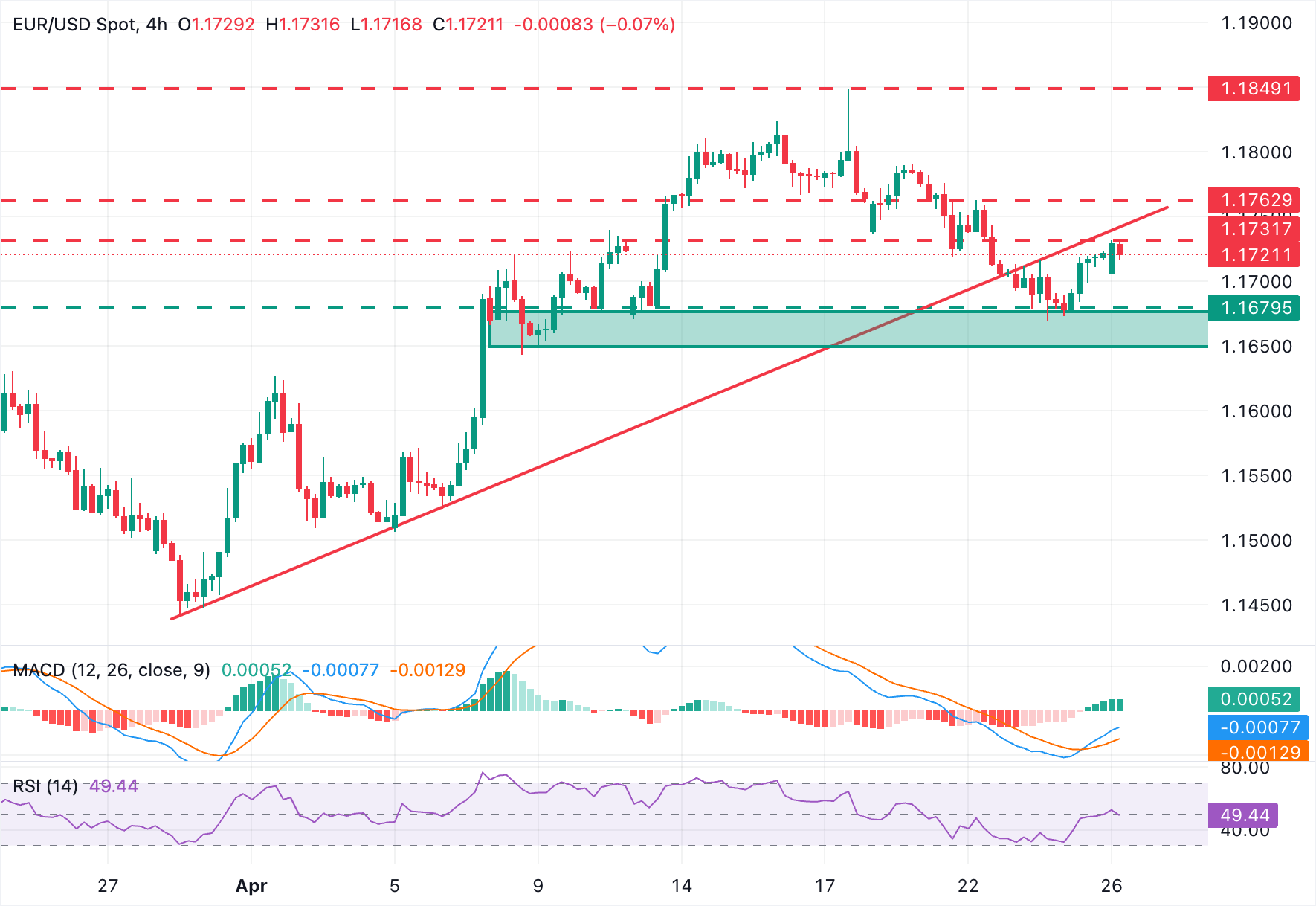
EUR/USD bears were held at the top of a cluster of support levels, between 1.1645 and 1.1675 on Friday, which allowed the pair to regain some of the ground lost earlier last week and return above 1.1700. Bulls, however, are struggling to overcome resistance at a previous support level right above 1.1730 (April 19 low) ahead of the broken trendline, now around 1.1745.
Technical indicators on the 4-hour chart are mildly bullish. The Relative Strength Index (RSI) is wavering around 50, showing a neutral tone, while the Moving Average Convergence Divergence (MACD) has turned marginally positive, hinting at fading downside momentum but not yet strong enough to negate the overhead supply zone.
Bulls should confirm above the mentioned trendline, at 1.1745, to consolidate an upwards reversal and shift the focus to the April 22 highs, near 1.1760, and April's peak, at 1.1849. Bearish attempts, on the flip side, are likely to find support between 1.1745 and 1.1755, which held the pair several times in mid-April. Further down, the next target is April's bottom, between 1.1505 and 1.1525.
(The technical analysis of this story was written with the help of an AI tool.)
Economic Indicator
GfK Consumer Confidence Survey
The GfK Consumer Confidence is a leading index that measures the level of consumer confidence in economic activity. A high level of consumer confidence stimulates economic expansion while a low level drives to economic downturn. Generally speaking, a high reading is positive (or bullish) for the EUR, while a low reading is seen as negative (or bearish).
Read more.Last release: Mon Apr 27, 2026 06:00
Frequency: Monthly
Actual: -33.3
Consensus: -29.5
Previous: -28
Source: Growth from Knowledge