
Gold price plunges as Oil shock sends yields soaring
- Gold slides as Iran tensions send Oil prices higher.
- US yields surge, boosting Dollar demand across markets.
- Fed hike bets grow as inflation fears dominate trading.
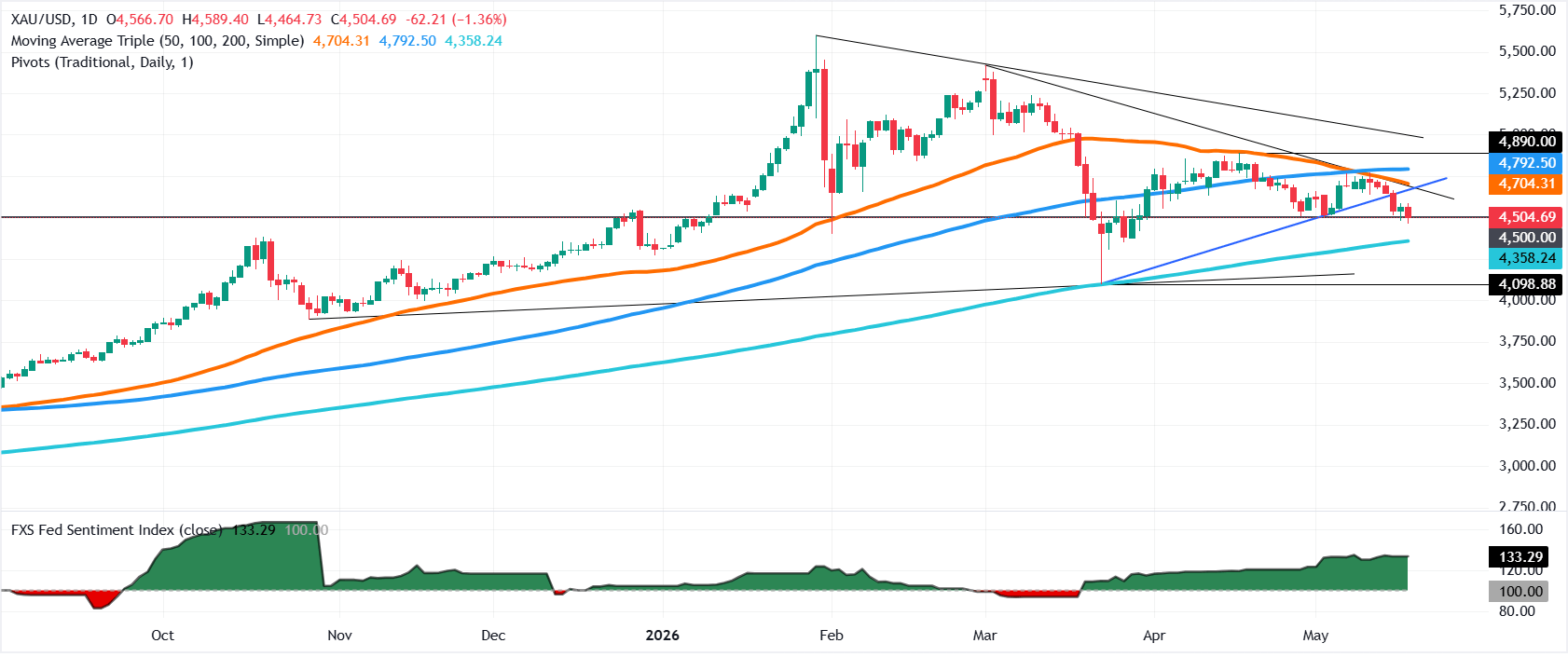
Gold (XAU/USD) price falls over 1.3% on Tuesday as the Greenback posts solid gains underpinned by US Treasury yields, with the 10-year note yield near a 16-month peak. At the time of writing, XAU/USD trades at $4,506 after reaching a high of $4,589.
XAU/USD tumbles as Fed hike bets punish bullion demand
Geopolitics continue to drive price action as the US-Iran conflict resolution seems to have stalled, even though US allies in the Gulf are pushing for a last effort to strike a deal that could satisfy both parties. In the meantime, tensions remained high, even though US President Donald Trump said he refrained from attacking Iran on Tuesday.
Iranian media revealed that Tehran’s last proposal reportedly remains unchanged from its previous offer, delaying talks over uranium enrichment.
Oil extended its rally to its fourth straight day, with West Texas Intermediate (WTI) up 1.57% at $104.07 per barrel, despite Trump’s optimism of reaching an agreement with Tehran. Recently, he told reporters that “I was an hour away from making the decision to go today,” hinting at a resumption of the conflict.
The energy shock has increased the likelihood that major central banks would need to step in and raise interest rates. The latest inflation readings,particularly in the US, with the Consumer Price Index (CPI) at 3.8% and the Producer Price Index (PPI) at 6%, pushed US Treasury yields higher, with the 30-year bond yield surpassing the 5% threshold, a level last seen in 2007.
Consequently, the Greenback is aiming higher. The US Dollar Index (DXY), which tracks the buck’s performance against a basket of six currencies, is up 0.31% at 99.26.
Money markets had priced a 50% chance that the Federal Reserve (Fed) would increase borrowing costs once, towards the end of the year, according to Prime Terminal data.
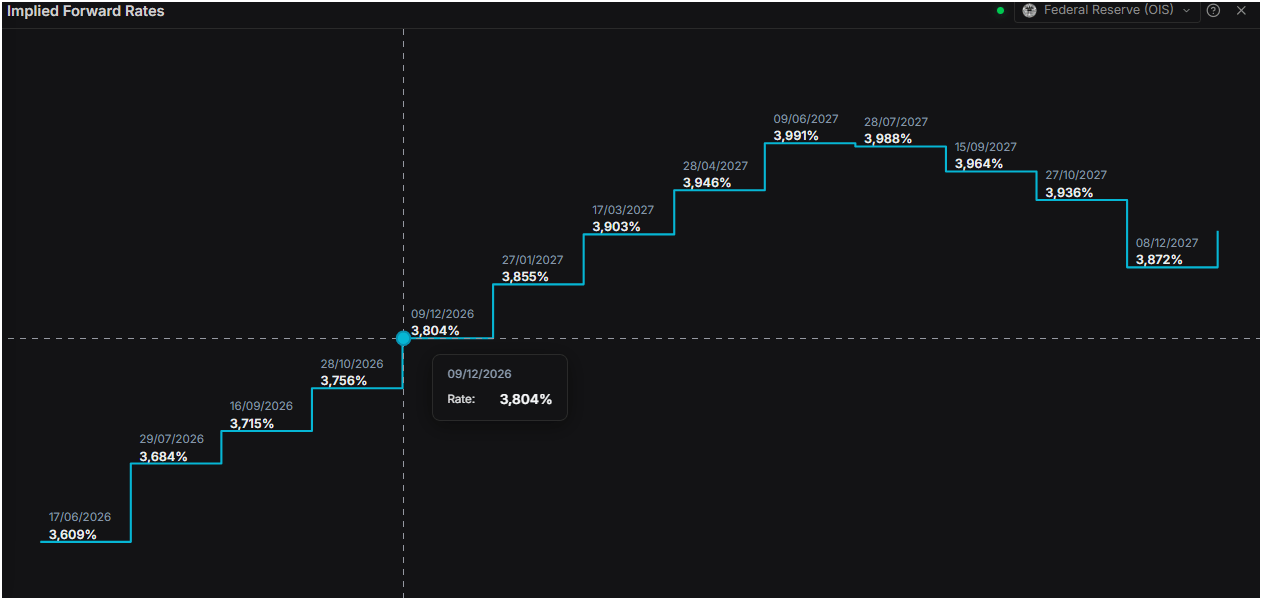
The US economic schedule will feature speeches by Fed officials, the minutes of the last FOMC monetary policy meeting and housing data.
XAU/USD technical analysis: Gold is neutral-to bearish biased, eyes on 200-day SMA
Gold is poised to consolidate further, capped on the upside by a confluence of technical resistance levels, including two-resistance trendlines and Simple Moving Averages (SMAs) looming above $4,600.
The Relative Strength Index (RSI) indicates that bears are in charge, suggesting the path of least resistance is downwards.
For a resumption of the downtrend, Gold must clear the $4,500 mark. Once surpassed, the next stop would be the May 19 low of $4,464, followed by the $4,400 milestone. A breach of the latter, and a move towards the 200-day SMA at $4,334 is on the cards.
On the flip side, if XAU/USD clears $4,550, it opens the door to testing the confluence of an upward and a downward resistance trendline that coincides around $4,600. If those levels are taken out, the next area of interest would be the 20-day SMA at 4,638, ahead of challenging the 50-day SMA at $4,704.
Gold FAQs
Gold has played a key role in human’s history as it has been widely used as a store of value and medium of exchange. Currently, apart from its shine and usage for jewelry, the precious metal is widely seen as a safe-haven asset, meaning that it is considered a good investment during turbulent times. Gold is also widely seen as a hedge against inflation and against depreciating currencies as it doesn’t rely on any specific issuer or government.
Central banks are the biggest Gold holders. In their aim to support their currencies in turbulent times, central banks tend to diversify their reserves and buy Gold to improve the perceived strength of the economy and the currency. High Gold reserves can be a source of trust for a country’s solvency. Central banks added 1,136 tonnes of Gold worth around $70 billion to their reserves in 2022, according to data from the World Gold Council. This is the highest yearly purchase since records began. Central banks from emerging economies such as China, India and Turkey are quickly increasing their Gold reserves.
Gold has an inverse correlation with the US Dollar and US Treasuries, which are both major reserve and safe-haven assets. When the Dollar depreciates, Gold tends to rise, enabling investors and central banks to diversify their assets in turbulent times. Gold is also inversely correlated with risk assets. A rally in the stock market tends to weaken Gold price, while sell-offs in riskier markets tend to favor the precious metal.
The price can move due to a wide range of factors. Geopolitical instability or fears of a deep recession can quickly make Gold price escalate due to its safe-haven status. As a yield-less asset, Gold tends to rise with lower interest rates, while higher cost of money usually weighs down on the yellow metal. Still, most moves depend on how the US Dollar (USD) behaves as the asset is priced in dollars (XAU/USD). A strong Dollar tends to keep the price of Gold controlled, whereas a weaker Dollar is likely to push Gold prices up.