
USD/CAD Price Forecast: Bearish Hanging Man reversal pattern confirmed
- USD/CAD formed a Japanese candlestick reversal pattern on Wednesday.
- Price could be about to fall in a large ABC or Measured Move price pattern.
USD/CAD formed a Hanging Man candlestick reversal pattern (blue rectangle on chart below) on Wednesday which suggests more downside is likely for the pair in the near-term. The pattern gained confirmation after Thursday ended as a long, red, down day.
USD/CAD Daily Chart
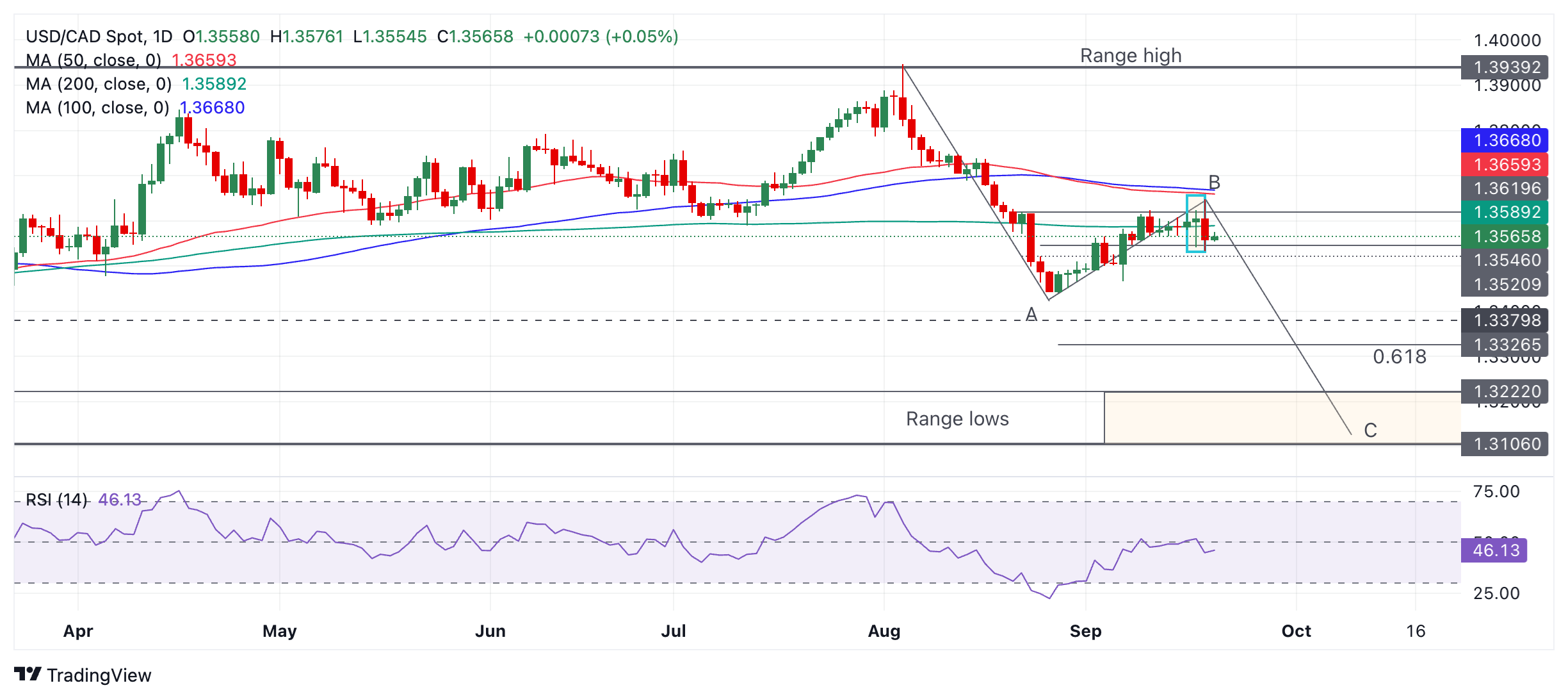
The Hanging Man forms when price rises to a new higher high, pulls back down during the same day, then recovers again and closes the day close to where it opened. If it is followed by a red down day – as was the case with USD/CAD – a short-term bearish reversal is heralded.
USD/CAD’s move down from the range high looks like it is conforming to an ABC pattern, or “Measured Move” (see labels on chart above). Such patterns are like large zig-zags. The wave C usually reaches a similar length to wave A or at a minimum is a Fibonacci 61.8% of A.
If USD/CAD is really forming an ABC pattern then wave C is probably about to unfold and go substantially lower. Such a down leg would probably fall to the zone of the range lows (orange shaded rectangle on chart above). The 61.8% target, meanwhile, lies at 1.3326.
It is still a little early to be sure that USD/CAD has reversed and will fall further. A break below 1.3533 (September 19 low) would provide added bearish confirmation, and a break below 1.3466 (September 6) even more solid confirmation.