
Dow Jones Industrial Average surges 1,050 points as stocks rebound from tech selloff
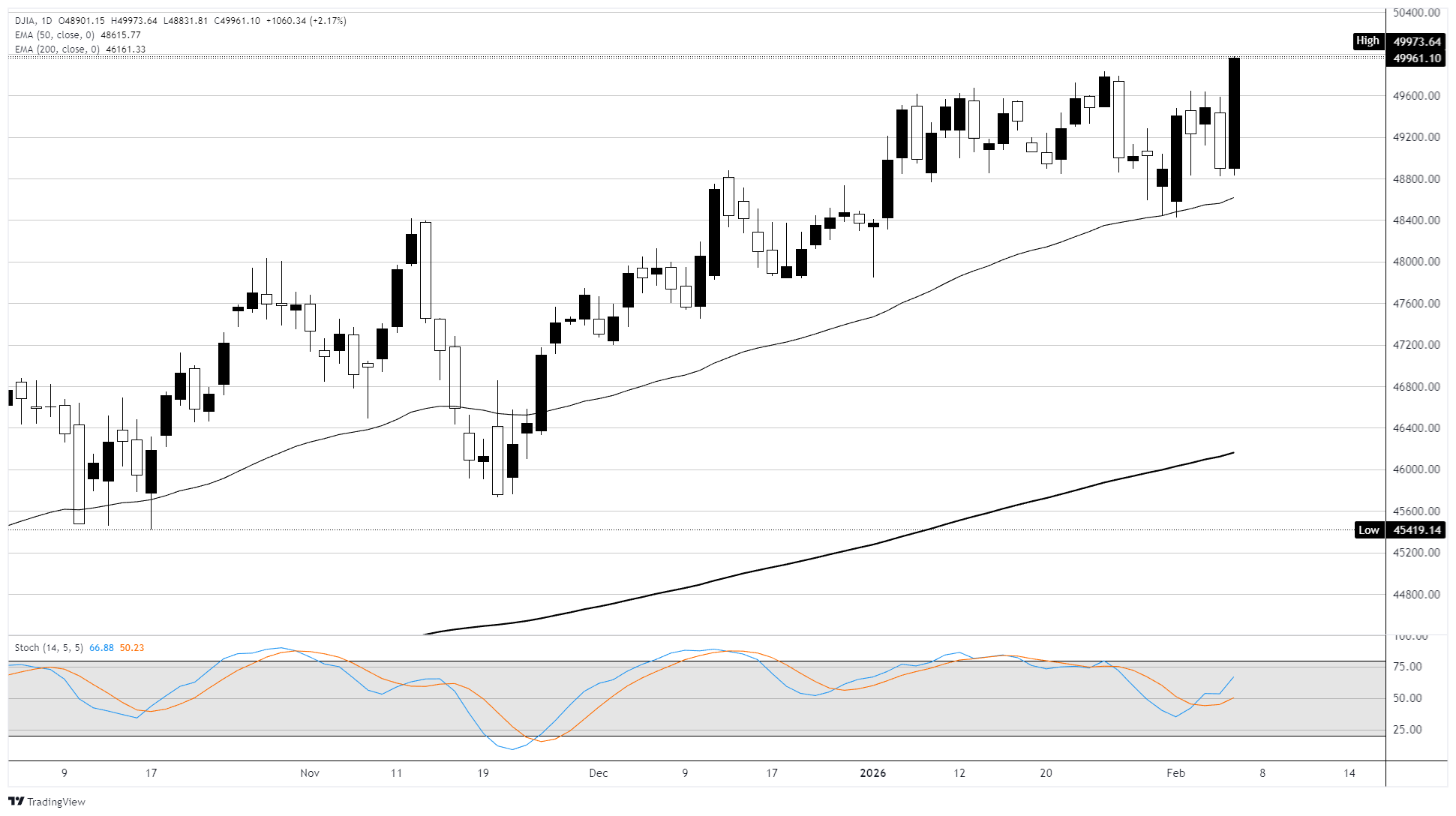
- The Dow climbed 1,050 points, or 2.15%, closing at 49,958.72, a fresh record high.
- Chipmakers rallied as investor fears about massive Big Tech AI spending eased, with Nvidia gaining 5% and AMD surging more than 5%.
- Amazon plunged 9% after announcing plans to spend $200 billion on AI infrastructure in 2026, raising concerns about returns on capital.
- Consumer sentiment unexpectedly rose to a six-month high of 57.3, driven by gains among wealthier Americans with stock market exposure.
The Dow Jones Industrial Average surged 1,050 points, or 2.15%, to close at 49,958.72, a fresh record high on Friday as stocks rebounded sharply from Thursday's tech-led selloff. The S&P; 500 climbed 1.2% to 6,880.13, while the Nasdaq Composite advanced 1.0% to 22,765.45. The strong rebound came as investors reassessed concerns about artificial intelligence disruption and the impact of massive spending plans from Big Tech companies, with chipmakers and financials leading the market higher.
Chipmakers rebound as AI infrastructure spending fears ease
Semiconductor stocks staged a powerful rally on Friday as investors looked past concerns about the sustainability of artificial intelligence investments. Nvidia Corporation (NVDA) surged approximately 5%, leading the charge higher after falling more than 1% in the previous session. Advanced Micro Devices Inc. (AMD) jumped 5.1%, while Broadcom gained 3.5% and Micron Technology climbed 4%. The rebound came as analysts emphasized that Big Tech's combined capital expenditure plans totaling more than $630 billion in 2026 represent massive demand for AI chips and data center infrastructure. Despite near-term concerns about when AI investments will generate returns, the spending spree is expected to benefit semiconductor manufacturers who supply the hardware powering the artificial intelligence buildout.
Amazon shares crater on $200 billion AI spending announcement
Amazon (AMZN) plunged nearly 9% after the e-commerce and cloud giant announced plans to spend approximately $200 billion on capital expenditures in 2026, far exceeding the $144 billion analysts had expected. The massive spending plan, focused on data centers, chips, and networking equipment to support artificial intelligence workloads, spooked investors who questioned whether Amazon Web Services can generate sufficient returns to justify the unprecedented level of investment. CEO Andy Jassy defended the spending during the company's earnings call, stating the company has strong demand signals and is immediately monetizing new capacity. However, at least five brokerages cut their price targets on Amazon following the announcement. The company's first-quarter operating income guidance of $16.5 billion to $21.5 billion also fell short of the $22 billion analysts expected, adding to concerns about near-term profitability.
Financials and industrials drive Dow to record high
Financial and industrial stocks powered the Dow's record-setting performance on Friday, benefiting from the broad market rebound and expectations for continued economic growth. JPMorgan Chase (JPM) climbed 3.2%, while Bank of America added 1.6% as banking stocks rallied on optimism about lending conditions. Among industrial names, Caterpillar Inc. (CAT) surged 3.9%, helping lead the Dow higher. Oracle Corporation (ORCL) jumped 4.1% as investors looked past concerns about cloud computing margins. The gains in cyclical sectors reflected a rotation away from the most expensive technology names and into stocks more closely tied to economic activity, continuing a trend that has supported the Dow's outperformance relative to the Nasdaq in recent weeks.
Consumer sentiment hits six-month high despite lingering concerns
The University of Michigan's preliminary February Consumer Sentiment Index rose to 57.3, up from 56.4 in January and exceeding economist expectations of 55.0. The reading marked the highest level since August 2025, though it remained approximately 20% below year-ago levels and near historically low readings. The improvement was driven primarily by wealthier Americans with stock market exposure who have benefited from equity gains, while sentiment stagnated among consumers without stock holdings. Joanne Hsu, director of the surveys, noted that concerns about high prices and elevated job loss risk continue to weigh on Americans. Year-ahead inflation expectations fell to 3.5% from 4.0% in January, providing some relief, though the overall sentiment level remains depressed from a historical perspective.
Healthcare stocks tumble on profit warnings
Molina Healthcare Inc. (MOH) plunged 28% after the health insurer forecast 2026 adjusted earnings of at least $5.00 per share, drastically below the $13.71 consensus estimate and representing less than half of Wall Street's expectations. The company also announced plans to exit its traditional Medicare Advantage Part D prescription drug business in 2027 due to underperformance. The disappointing outlook, driven by elevated medical costs across government-backed health plans and a $2.50 per share hit from implementing a new Florida Medicaid contract, raised concerns about broader managed care industry pressures. CEO Joseph Zubretsky characterized 2026 as a "trough year for Medicaid industry margins" as healthcare providers struggle with the imbalance between reimbursement rates and rising utilization trends.
Dow Jones daily chart
Dow Jones FAQs
The Dow Jones Industrial Average, one of the oldest stock market indices in the world, is compiled of the 30 most traded stocks in the US. The index is price-weighted rather than weighted by capitalization. It is calculated by summing the prices of the constituent stocks and dividing them by a factor, currently 0.152. The index was founded by Charles Dow, who also founded the Wall Street Journal. In later years it has been criticized for not being broadly representative enough because it only tracks 30 conglomerates, unlike broader indices such as the S&P 500.
Many different factors drive the Dow Jones Industrial Average (DJIA). The aggregate performance of the component companies revealed in quarterly company earnings reports is the main one. US and global macroeconomic data also contributes as it impacts on investor sentiment. The level of interest rates, set by the Federal Reserve (Fed), also influences the DJIA as it affects the cost of credit, on which many corporations are heavily reliant. Therefore, inflation can be a major driver as well as other metrics which impact the Fed decisions.
Dow Theory is a method for identifying the primary trend of the stock market developed by Charles Dow. A key step is to compare the direction of the Dow Jones Industrial Average (DJIA) and the Dow Jones Transportation Average (DJTA) and only follow trends where both are moving in the same direction. Volume is a confirmatory criteria. The theory uses elements of peak and trough analysis. Dow’s theory posits three trend phases: accumulation, when smart money starts buying or selling; public participation, when the wider public joins in; and distribution, when the smart money exits.
There are a number of ways to trade the DJIA. One is to use ETFs which allow investors to trade the DJIA as a single security, rather than having to buy shares in all 30 constituent companies. A leading example is the SPDR Dow Jones Industrial Average ETF (DIA). DJIA futures contracts enable traders to speculate on the future value of the index and Options provide the right, but not the obligation, to buy or sell the index at a predetermined price in the future. Mutual funds enable investors to buy a share of a diversified portfolio of DJIA stocks thus providing exposure to the overall index.