
Gold trades sideways as strong US jobs data push back early Fed rate-cut bets
- Gold trades sideways above $5,000, remaining capped inside this week’s consolidation range.
- Stronger US Nonfarm Payrolls data reinforce a hold-for-longer Fed outlook, keeping near-term rate-cut expectations in check.
- Elevated US-Iran tensions continue to underpin safe-haven demand, helping to cushion downside risks for Gold.
Gold (XAU/USD) holds in a narrow range on Thursday as stronger US employment data prompts traders to push back expectations for an early Federal Reserve (Fed) interest rate cut. At the time of writing, XAU/USD trades around $5,065, remaining confined to this week’s $5,000-$5,100 consolidation band.
US employment data strengthens case for a hold-for-longer Fed stance
Data released on Wednesday by the US Bureau of Labor Statistics (BLS) showed an unexpected pickup in job growth in the US economy. Nonfarm Payrolls (NFP) rose by 130K in January, well above expectations of 70K and marking the strongest monthly job gain since December 2024. At the same time, the Unemployment Rate edged lower to 4.3% from 4.4%.
The stronger labour data reduces the scope for near-term monetary policy easing, reinforcing expectations that the Fed is likely to remain on hold over the next couple of meetings. This acts as a modest headwind for Gold, given its non-interest-bearing nature.
However, the US Dollar (USD) and Treasury yields have failed to attract meaningful follow-through buying after the report, offering some support to the Bullion. The US Dollar Index (DXY), which tracks the Greenback's value against a basket of six major currencies, is trading around 96.80, hovering near one-week lows.
Traders also digested fresh comments from Fed officials on Wednesday. Kansas City Fed President Jeffrey Schmid said that further rate cuts could allow inflation to remain elevated for longer, adding that it is still appropriate to keep monetary policy restrictive with inflation close to 3%.
Separately, Beth Hammack said that the current federal funds rate is “right around neutral” and that it is appropriate for the Fed to stay on hold, noting that rates are not putting much restraint on the economy and that there is no need to fine-tune policy at this stage.
Even so, markets are still pricing in close to 50 basis points of easing for this year, with the CME FedWatch Tool pointing to the first rate cut most likely in the June-July window. Attention now turns to the US Consumer Price Index (CPI) release on Friday.
Elsewhere, US-Iran tensions remain elevated, keeping geopolitical risks firmly in play and helping to cushion the downside in Bullion. The Wall Street Journal reported on Wednesday that the United States is preparing to deploy a second aircraft-carrier strike group to the Middle East, as the US military readies for the possibility of military action if negotiations over Iran’s nuclear programme were to fail.
Against this backdrop, Gold is likely to remain range-bound in the near term, as fading expectations for early Fed rate cuts are offset by lingering geopolitical risks.
Technical analysis: XAU/USD consolidates above $5,000 as momentum fades
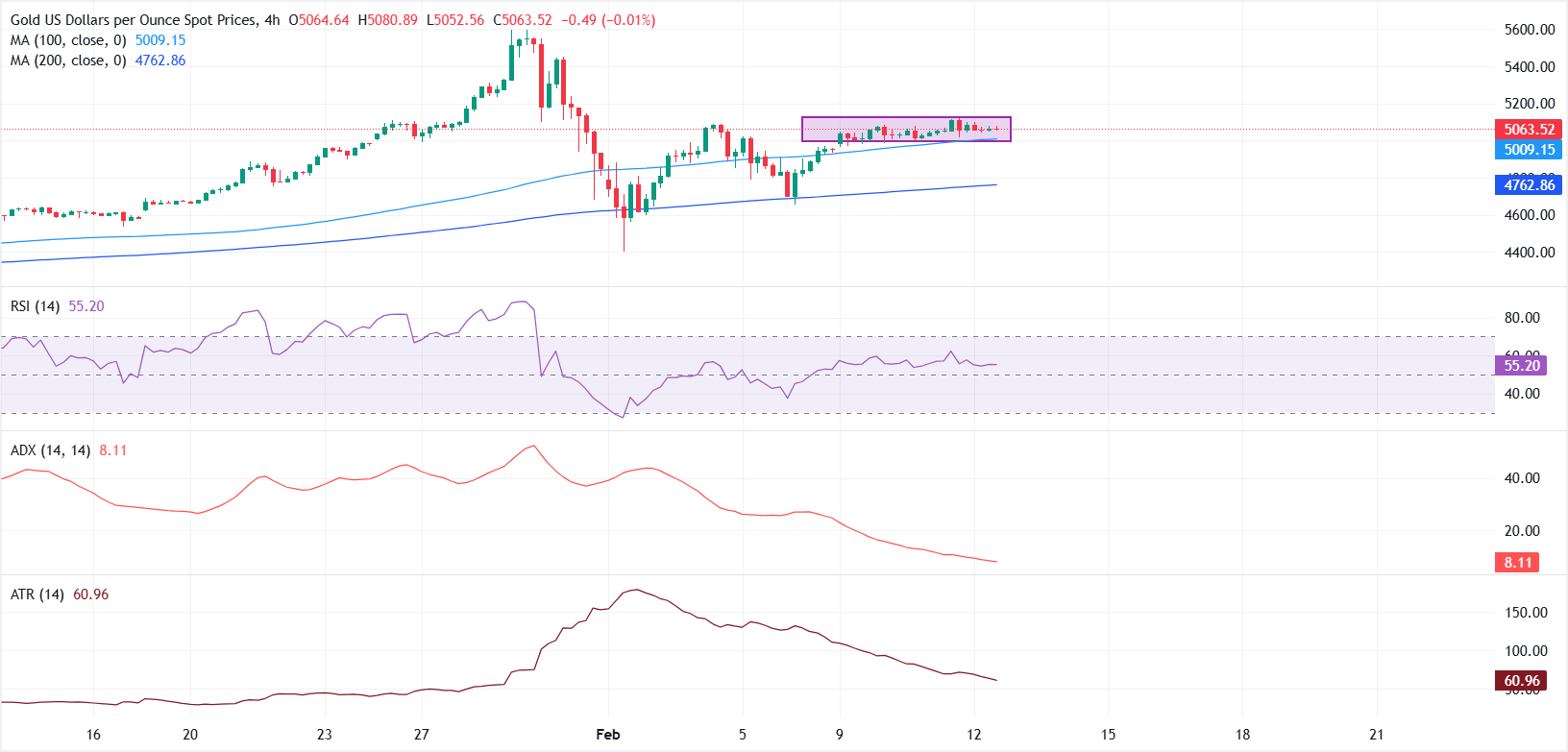
From a technical perspective, short-term momentum has cooled after the recent sharp correction, signalling that Gold is entering a consolidation phase. The Relative Strength Index (RSI) hovers around 55, reflecting a neutral near-term bias. The Average Directional Index (ADX) is near 8, indicating very weak trend strength, while the Average True Range (ATR) has started to roll over, showing that price volatility is easing.
On the 4-hour chart, XAU/USD is stabilising above the 100-period Simple Moving Average (SMA) near the $5,000 psychological level. A sustained break below this area would increase downside pressure, with the next support seen near $4,850, followed by the 200-period SMA.
On the upside, a break above $5,100 is needed to revive bullish momentum. The broader uptrend, however, remains intact.
Gold FAQs
Gold has played a key role in human’s history as it has been widely used as a store of value and medium of exchange. Currently, apart from its shine and usage for jewelry, the precious metal is widely seen as a safe-haven asset, meaning that it is considered a good investment during turbulent times. Gold is also widely seen as a hedge against inflation and against depreciating currencies as it doesn’t rely on any specific issuer or government.
Central banks are the biggest Gold holders. In their aim to support their currencies in turbulent times, central banks tend to diversify their reserves and buy Gold to improve the perceived strength of the economy and the currency. High Gold reserves can be a source of trust for a country’s solvency. Central banks added 1,136 tonnes of Gold worth around $70 billion to their reserves in 2022, according to data from the World Gold Council. This is the highest yearly purchase since records began. Central banks from emerging economies such as China, India and Turkey are quickly increasing their Gold reserves.
Gold has an inverse correlation with the US Dollar and US Treasuries, which are both major reserve and safe-haven assets. When the Dollar depreciates, Gold tends to rise, enabling investors and central banks to diversify their assets in turbulent times. Gold is also inversely correlated with risk assets. A rally in the stock market tends to weaken Gold price, while sell-offs in riskier markets tend to favor the precious metal.
The price can move due to a wide range of factors. Geopolitical instability or fears of a deep recession can quickly make Gold price escalate due to its safe-haven status. As a yield-less asset, Gold tends to rise with lower interest rates, while higher cost of money usually weighs down on the yellow metal. Still, most moves depend on how the US Dollar (USD) behaves as the asset is priced in dollars (XAU/USD). A strong Dollar tends to keep the price of Gold controlled, whereas a weaker Dollar is likely to push Gold prices up.