
Dow Jones Industrial Average treads water as semiconductors extend record streak
- DJIA futures hover just below the flatline as the S&P 500 prints a fresh record high on chip stock momentum.
- PHLX Semiconductor index stretches its winning streak to 16 sessions, the longest on record, with Texas Instruments leading the charge.
- IBM and ServiceNow slump on disappointing earnings, while United Rentals rallies to top the S&P 500.
- Trump orders the Navy to strike any vessel laying mines in the Strait of Hormuz, keeping geopolitical risk on the radar.
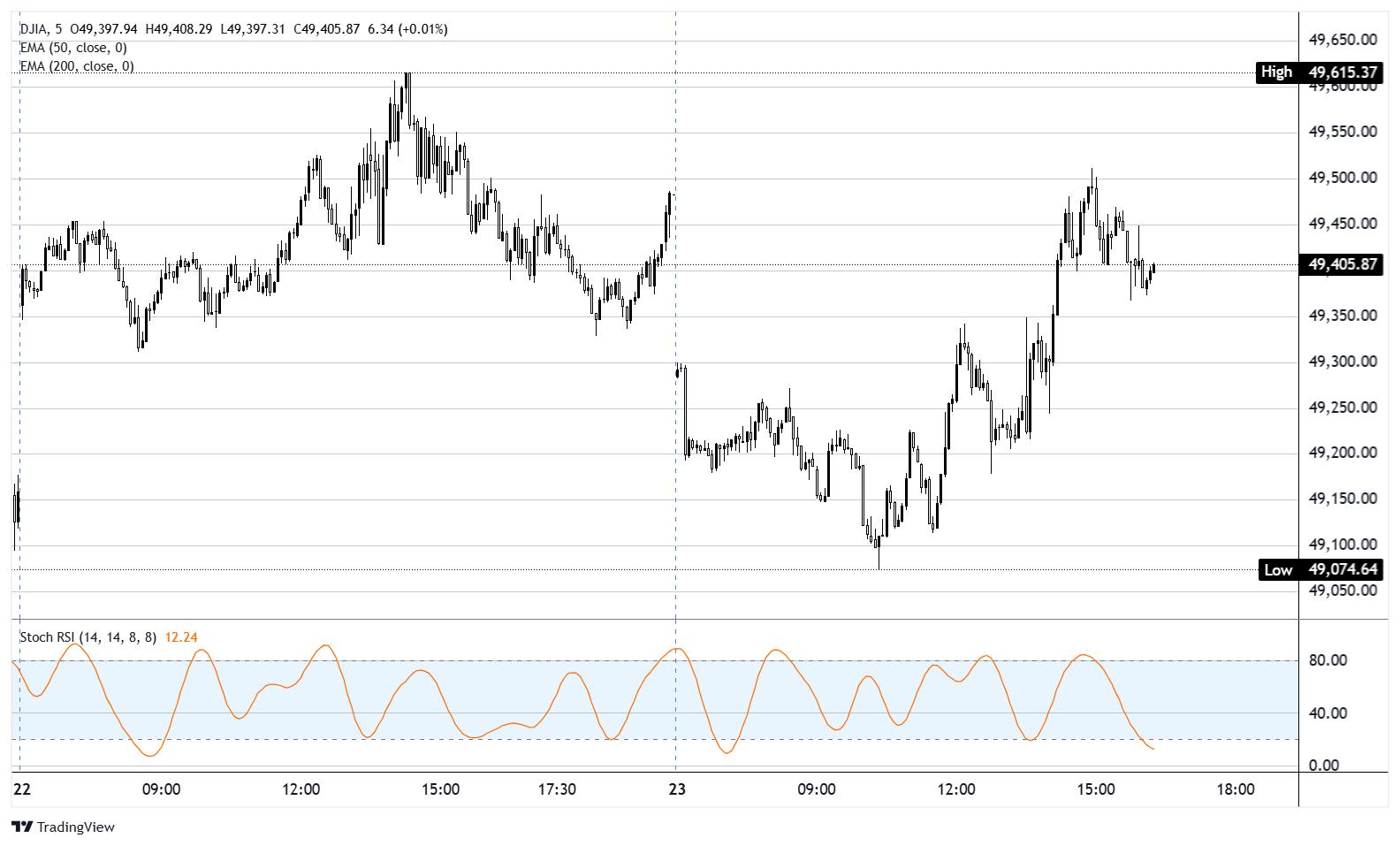
Dow Jones Industrial Average (DJIA) futures are drifting near 49,400 on Thursday, trading just below the flatline after swinging between 49,100 and 49,600 over the past two sessions. The broader tape is mixed: the S&P 500 has punched through to a fresh record high, rising 0.1%, while the Nasdaq Composite slips 0.1% as rotation favors industrial and cyclical names over mega-cap tech. Risk appetite is holding up despite renewed Middle East headlines, with equities largely range-bound as traders digest a heavy earnings slate and upbeat activity data.
Semiconductors power S&P 500 to record
The PHLX Semiconductor index (SOX) has jumped 2.9%, stretching its winning streak to 16 sessions, the longest on record. Texas Instruments (TXN) is the clear standout, soaring more than 18% after a better-than-expected quarterly report paired with upbeat forward guidance, pulling the rest of the chip space higher. The relentless bid in semis continues to mask weakness elsewhere in growth-oriented tech, and it remains the single most important driver behind the S&P 500's push to new highs. Whether the group can hold its bid into next week's slate of mega-cap earnings is the key question for index bulls.
Earnings shake out clear winners and losers
Outside of chips, the earnings picture is a mixed bag and it is hitting individual names hard. IBM (IBM) has dropped 8% after its latest numbers disappointed, while ServiceNow (NOW) has cratered 17% on a weaker-than-hoped outlook, dragging software peers broadly lower. On the other side of the ledger, United Rentals (URI) has surged 20% to lead the entire S&P 500, a move that signals investors are rewarding exposure to construction and industrial demand. That rotation into industrial cyclicals is one reason the Dow is holding up better than the Nasdaq, even with the big tech pullback.
Activity data runs hot, jobless claims tick up
Thursday's US macro slate leaned firmer on growth. S&P Global's flash Purchasing Managers Index (PMI) readings for April came in strong across the board, with the Composite at 52, Manufacturing at 54 against a 52.5 consensus, and Services at 51.3 versus 50 expected. All three readings sit comfortably above the 50 expansion threshold, pointing to an economy still running warm entering the second quarter. Initial Jobless Claims edged up to 214K versus the 212K consensus and 208K prior, a modest softening that is unlikely to move the Federal Reserve (Fed) on its own. Taken together, the data gives the Fed little reason to rush into further easing.
Middle East risk stays on the radar
Geopolitics remain a background drag. President Donald Trump ordered the Navy to "shoot and kill any boat" laying mines in the Strait of Hormuz, posting that there should be no hesitation. The directive follows his comments earlier this week that Tehran's government was fractured enough to warrant a ceasefire extension. Traders are treating the headlines with the same increasingly desensitized stance seen in recent sessions, but any escalation that disrupts energy flows would quickly hit equity risk sentiment and push Oil higher.
Looking ahead, Friday's US session brings the final University of Michigan (UoM) Consumer Sentiment and Consumer Expectations readings for April at 14:00 GMT, alongside 1-year and 5-year consumer inflation expectations. With the Fed still in wait-and-see mode and mega-cap earnings looming next week, the path of least resistance for DJIA futures looks tied to how the earnings rotation unfolds. Analysts at Barnum Financial Group note that stocks appear less reactive to Iran headlines and are pivoting toward earnings, fundamentals and Fed policy, suggesting a range-bound grind until the next major catalyst arrives.
Dow Jones 5-minute chart
Dow Jones FAQs
The Dow Jones Industrial Average, one of the oldest stock market indices in the world, is compiled of the 30 most traded stocks in the US. The index is price-weighted rather than weighted by capitalization. It is calculated by summing the prices of the constituent stocks and dividing them by a factor, currently 0.152. The index was founded by Charles Dow, who also founded the Wall Street Journal. In later years it has been criticized for not being broadly representative enough because it only tracks 30 conglomerates, unlike broader indices such as the S&P 500.
Many different factors drive the Dow Jones Industrial Average (DJIA). The aggregate performance of the component companies revealed in quarterly company earnings reports is the main one. US and global macroeconomic data also contributes as it impacts on investor sentiment. The level of interest rates, set by the Federal Reserve (Fed), also influences the DJIA as it affects the cost of credit, on which many corporations are heavily reliant. Therefore, inflation can be a major driver as well as other metrics which impact the Fed decisions.
Dow Theory is a method for identifying the primary trend of the stock market developed by Charles Dow. A key step is to compare the direction of the Dow Jones Industrial Average (DJIA) and the Dow Jones Transportation Average (DJTA) and only follow trends where both are moving in the same direction. Volume is a confirmatory criteria. The theory uses elements of peak and trough analysis. Dow’s theory posits three trend phases: accumulation, when smart money starts buying or selling; public participation, when the wider public joins in; and distribution, when the smart money exits.
There are a number of ways to trade the DJIA. One is to use ETFs which allow investors to trade the DJIA as a single security, rather than having to buy shares in all 30 constituent companies. A leading example is the SPDR Dow Jones Industrial Average ETF (DIA). DJIA futures contracts enable traders to speculate on the future value of the index and Options provide the right, but not the obligation, to buy or sell the index at a predetermined price in the future. Mutual funds enable investors to buy a share of a diversified portfolio of DJIA stocks thus providing exposure to the overall index.