
AUD/USD jumps near 0.7200 as Japan’s intervention sinks the USD
- AUD/USD surged despite solid US GDP growth and Core PCE data.
- Japan’s FX intervention triggered broad US Dollar weakness across major currencies.
- RBA hike expectations strengthened after Australia’s hotter quarterly CPI print.
The Australian Dollar reclaimed the 0.7200 level on Thursday, surging more than 1% as the Greenback dropped to seven-day lows amid Japanese authorities’ intervention in the FX markets, pushing aside solid US economic data. The AUD/USD trades past 0.7200 after hitting a daily low of 0.7110.
Aussie rallies as RBA hike bets and weak Dollar overpower US data
The Greenback’s fall is driving the financial markets, tumbling 0.91% as depicted by the US Dollar Index (DYX). The DXY, which tracks the US Dollar’s performance against a basket of six currencies, falls toward 98.00 after the USD/JPY collapsed by over 400 pips during Thursday’s Asian-European session, amid a confirmed intervention in the FX space.
Reuters reported, “Japan intervened to prop up the yen against the US Dollar on Thursday, its first official currency action in nearly two years, two sources familiar with the matter told Reuters.”.
In the meantime, major central banks like the European Central Bank and the Bank of England have finished the central bank bonanza, delivering hawkish holds amid higher energy prices, which are strengthening the case for keeping rates “higher for longer.”
Data from the US showed that the economy grew 2% in Q1 2026, slightly below the 2.3% estimate. Spending on AI and investment in data centers increased at a rate of 17.2%, up from a modest 4.3% in the last quarter of 2025.
At the same time, the Federal Reserve’s preferred inflation gauge, the Core PCE, rose by 3.2% YoY in March as expected, up from 3%, its highest level in almost three years. US initial jobless claims in the week ending April 25 rose by 189K, below estimates of 215K people expected to file for unemployment benefits.
RBA expected to hike in May's meeting
In Australia, the economic docket will feature the Producer Price Index (PPI) for Q1 2026, after the latest Consumer Price Index (CPI) released on April 28 rose by over 4.1% in Q1, up from 3.6%.
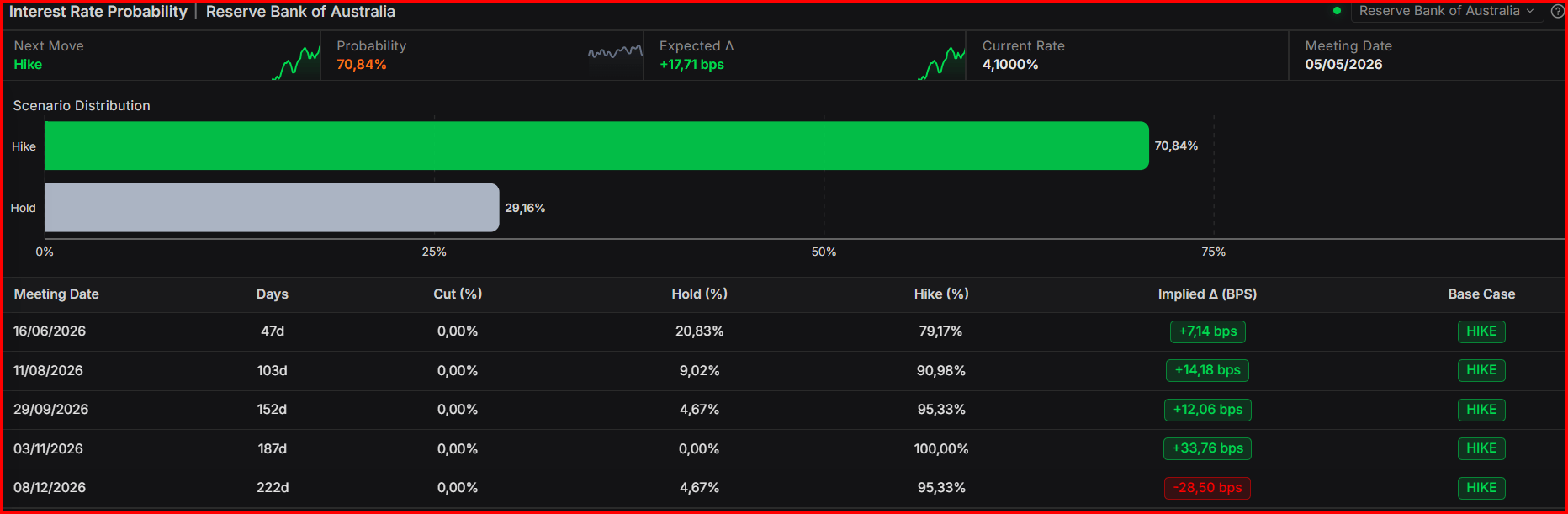
Money markets are pricing in a 70% chance that the Reserve Bank of Australia (RBA) will raise rates to 4.35% at the May 5 meeting, according to Prime Terminal data.
In the US, the economic calendar will feature the ISM Manufacturing PMI for April, expected to expand to 53, up from March’s unexpected 52.7.
AUD/USD Price Forecast: Technical outlook
In the daily chart, AUD/USD trades at 0.7201, maintaining a constructive bullish bias as it holds above the near-term upward trend-line support around 0.7074 and the cluster of simple moving averages (SMA) centered near 0.7059. The pair has also reclaimed the longer-term downward trend structure, turning the former bearish line from 0.8015–0.6472 into an underlying floor, while a 14-day Relative Strength Index near 61 suggests firm but not yet overextended upside momentum.
On the downside, initial support is now seen at the 0.7201 area as an intraday pivot, followed by the rising trend-line zone near 0.7074 and the 50–200 day SMA band around 0.7059, with the reclaimed descending trend reference at 0.6472 acting as a deeper structural floor if a sharper correction unfolds. On the topside, a sustained push higher would expose the next resistance band defined by the higher ascending trend structures, with the first notable cap emerging near 0.7558 and a more distant barrier aligned with the broader rising trajectory around 0.7858.
(The technical analysis of this story was written with the help of an AI tool.)
Australian Dollar FAQs
One of the most significant factors for the Australian Dollar (AUD) is the level of interest rates set by the Reserve Bank of Australia (RBA). Because Australia is a resource-rich country another key driver is the price of its biggest export, Iron Ore. The health of the Chinese economy, its largest trading partner, is a factor, as well as inflation in Australia, its growth rate and Trade Balance. Market sentiment – whether investors are taking on more risky assets (risk-on) or seeking safe-havens (risk-off) – is also a factor, with risk-on positive for AUD.
The Reserve Bank of Australia (RBA) influences the Australian Dollar (AUD) by setting the level of interest rates that Australian banks can lend to each other. This influences the level of interest rates in the economy as a whole. The main goal of the RBA is to maintain a stable inflation rate of 2-3% by adjusting interest rates up or down. Relatively high interest rates compared to other major central banks support the AUD, and the opposite for relatively low. The RBA can also use quantitative easing and tightening to influence credit conditions, with the former AUD-negative and the latter AUD-positive.
China is Australia’s largest trading partner so the health of the Chinese economy is a major influence on the value of the Australian Dollar (AUD). When the Chinese economy is doing well it purchases more raw materials, goods and services from Australia, lifting demand for the AUD, and pushing up its value. The opposite is the case when the Chinese economy is not growing as fast as expected. Positive or negative surprises in Chinese growth data, therefore, often have a direct impact on the Australian Dollar and its pairs.
Iron Ore is Australia’s largest export, accounting for $118 billion a year according to data from 2021, with China as its primary destination. The price of Iron Ore, therefore, can be a driver of the Australian Dollar. Generally, if the price of Iron Ore rises, AUD also goes up, as aggregate demand for the currency increases. The opposite is the case if the price of Iron Ore falls. Higher Iron Ore prices also tend to result in a greater likelihood of a positive Trade Balance for Australia, which is also positive of the AUD.
The Trade Balance, which is the difference between what a country earns from its exports versus what it pays for its imports, is another factor that can influence the value of the Australian Dollar. If Australia produces highly sought after exports, then its currency will gain in value purely from the surplus demand created from foreign buyers seeking to purchase its exports versus what it spends to purchase imports. Therefore, a positive net Trade Balance strengthens the AUD, with the opposite effect if the Trade Balance is negative.